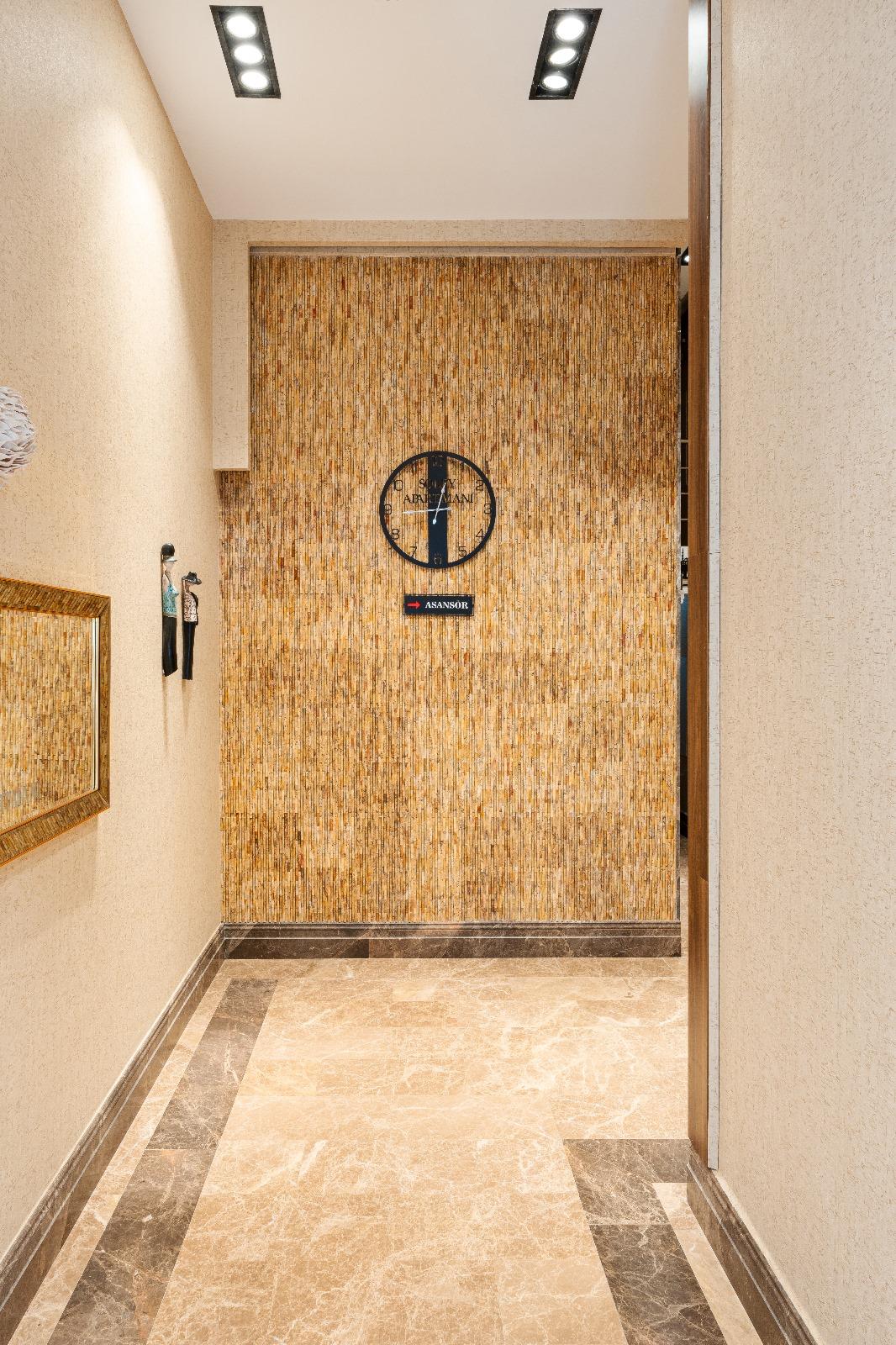
Travertine is a natural stone with a porous and holey structure, formed by the precipitation of calcium carbonate when hot spring waters reach the surface.
Bamboo Travertine
There are 3 main features that make it unique in the marble industry:
Natural Voids: Due to gas bubbles formed during its creation, it has a sponge-like, porous texture. These holes can be filled in factories with special fillers upon request.
Example of travertine for homes, residences, villas, and pools.
Heat & Slip Resistance: It does not overheat under the sun (does not burn feet) and is non-slip when wet, making it an essential material for poolside areas worldwide.
Turkey’s Strength: Turkey (especially Denizli and Afyon) has the highest quality travertine reserves in the world and is a global leader in this field.
In Summary: A “porous” natural stone that is lighter, more economical, and more suitable for outdoor use than marble.
Difference Between Marble and Travertine
From an industry perspective, the key features that distinguish travertine from marble and make it valuable can be summarized as follows:
1. Formation Difference (Industry Identity)
Marble forms underground under high pressure and heat, whereas travertine forms on the surface through precipitation when calcium carbonate-rich hot spring waters lose carbon dioxide rapidly.
Industry Note: This rapid formation causes gas bubbles to remain inside the stone, giving travertine its well-known porous/holey structure.
2. Character Change Based on Cutting Methods
The most important factor that makes travertine resemble marble in the industry is the cutting direction of the blocks:
Vein Cut (Turkish Cut / Along the Vein): A modern cut where the block is sliced vertically, showing parallel lines (veins).
Cross Cut (American Cut / Against the Vein): A traditional cut where the block is sliced horizontally, highlighting cloudy and circular patterns.
3. Surface Treatments and Filling Technology
Due to its natural pores, travertine requires more “intervention” during factory processing compared to marble:
Filled: Pores are filled with special cement or epoxy resins matching the stone color. Preferred for indoor use.
Unfilled: Natural holes are left open. Commonly used for rustic exterior cladding and pool areas.
Tumbled: The edges of the stone are rounded to give it an antique appearance.
4. Industry Usage Advantages
The reasons why travertine is preferred over marble in the industry are as follows:
Thermal Insulation: Its air-pocket structure prevents heat transfer as quickly as marble. It does not burn feet even under summer sun.
Slip Resistance: Its natural pores provide much better grip on wet surfaces (pool, bathroom) compared to marble.
Lightweight: It has a lower density than marble, reducing the load on building facades.
5. Turkey’s Industry Power in Travertine
Turkey is the global leader in travertine reserves and exports. Travertines from Denizli, Afyonkarahisar, and Sivas regions (Light, Medium, Noce, Silver) are recognized as a global standard under the “Turkish Travertine” brand.
Feature
Classic Marble
Travertine
Texture
Crystallized, homogeneous, veined
Porous, holey, layered
Hardness
Harder, more impact-resistant
Softer, easier to process
Thermal Conductivity
High (heats/cools quickly)
Low (retains temperature, does not burn feet)
Price
Very high for rare types
Generally more economical
Travertine
Most Frequently Asked Questions About Travertine
The most common questions about “travertine” generally revolve around its differences from marble, durability, price, and maintenance. Based on 2026 current data and user behavior, the most frequently asked questions are:
1. Technical and Comparative Questions
“Is travertine a type of marble?“
Answer: No, they are different stones. Marble forms underground under high pressure, while travertine forms on the surface around hot springs through precipitation.
“Is marble or travertine more durable?“
Marble is denser and harder; however, travertine is more preferred in outdoor areas due to its flexibility and heat resistance (does not burn feet in summer).
“Why is travertine porous/holey?“
Gases and water released during its formation leave these pores. These pores can be filled in factories or left natural depending on preference.
2. Usage Area Questions
“Why is travertine preferred around pools?“
One of the most frequently asked questions. Answer: Because it is non-slip and does not retain heat under the sun (does not burn feet).
“Is travertine used in bathrooms or kitchens?”
Yes, but due to its porous structure, “filled” and “sealed” (with sealant) versions must be preferred.
“Does travertine fall off on exterior facades?“
With proper installation (mechanical anchoring system) and quality stone selection, it is one of the most durable and insulation-friendly exterior materials.
3. Price and Cost Questions
“Is travertine cheaper than marble?“
Generally yes. Standard travertines are more economical than marble, but special colors like Silver or Noce can approach marble prices.
“What are the m² prices in 2026?“
Standard slab prices range between approximately 39$ and 79$, while special cuts or split-face stones may vary.
4. Maintenance and Cleaning Questions
“How to clean travertine?“
Critical Warning: Never use vinegar, hydrochloric acid, bleach, or lemon-based cleaners. These acidic substances damage the stone. Only pH-neutral soaps or special natural stone cleaners are recommended.
“Does travertine darken or stain?“
If not sealed (impregnated), its porous structure may absorb liquids and cause stains. It is recommended to apply protective treatment once a year.
5. New Trend: Furniture Questions
“Is a travertine table practical?“
It is one of the most popular searches in recent years. It offers a natural and luxurious look, but users are advised to wipe it immediately if acidic substances (wine, juice) are spilled on it.
We use cookies to ensure that we give you the best experience on our website. If you continue to use this site, it will mean that you have activated all cookies. For detailed information about cookies, please review the Cookie Clarification Text.